
The world of mobile telephony is constantly evolving, and with it, the technologies that keep us connected. For decades, the physical SIM card has been the standard for accessing mobile networks. But a major innovation is revolutionizing this approach: the eSIM.
This virtual SIM card, integrated directly into the device, simplifies access to mobile networks without requiring physical support. But what exactly is an eSIM? How does it work? And most importantly, how is it different from a traditional SIM card? All the answers are in this article!
What is an eSIM and how does it work?
The term « eSIM » means « Embedded SIM« , which is a SIM card integrated directly into a mobile device. It is a chip soldered to the motherboard of the phone or any other compatible device.
It works in the same way as a physical SIM card by authenticating the user to a mobile network. However, it does not require physical support and can be activated or reprogrammed remotely, without needing a card change. When a user wants to activate a mobile plan with an eSIM, they must follow a few simple steps:
- Order an eSIM plan from a mobile operator or a provider like Vostra.
- Receive a QR code or an activation code.
- Scan the QR code via your device’s settings.
- Configure the eSIM as a primary or secondary line.
- Activate the connection to mobile networks.
Once the eSIM is activated, the user can change plans or networks without having to remove a card.
In addition to smartphones (iPhone, Google Pixel, Samsung Galaxy, etc.) and tablets (iPad Pro, iPad Air, etc.), eSIMs can be configured on smartwatches (Apple Watch, Samsung Galaxy Watch, etc.) and certain laptops (Microsoft Surface, Lenovo ThinkPad, etc.).
The evolution of SIM cards
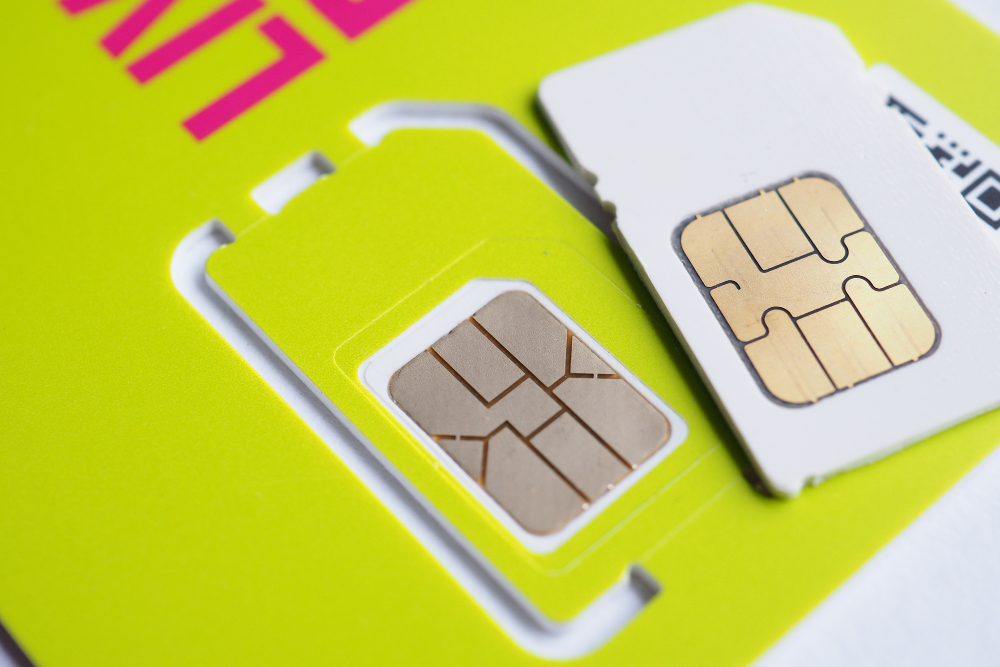
The SIM card has undergone numerous transformations since its appearance in the 1990s:
- Initially introduced in the 90s, the classic SIM card was the size of a credit card.
- Over the years, it was progressively reduced to become mini SIM, then micro SIM, and finally nano SIM, the most common format today.
- In 2017, the arrival of eSIMs marked a major advance by permanently integrating the chip inside the device. Presented at the Mobile World Congress (MWC), the eSIM then became the very first fully digital chip, offering unprecedented capabilities in terms of flexibility and security.
With the eSIM, the mobile industry is moving towards a dematerialized approach, where changing operators and plans is done in just a few clicks.
Differences between an eSIM and a physical SIM card
Although both types of chips (physical and digital) serve the same fundamental purpose, eSIMs offer several significant advantages:
📌 Features of physical SIM cards
- Require manual insertion and removal.
- Can be lost or damaged.
- Do not allow instant network switching.
- Require physical availability (purchase and delivery).
📌 Features of eSIMs
- Integrated directly into the device.
- Activatable and reprogrammable remotely.
- Impossible to lose or steal.
- Ideal for travelers thanks to quick switching between operators.
- Compatible with multiple plans simultaneously.
How to activate an eSIM?

Generally, after purchasing your eSIM plan from a provider like Vostra, you immediately receive an email containing detailed instructions on how to activate it. Here are the key steps:
- Purchase your eSIM from an online provider (like Vostra).
- Receive an email or check the app for instructions on how to install your eSIM profile.
- Follow the steps indicated on your smartphone (usually by scanning a QR code or manually entering a provided code).
- Your eSIM activates in a few moments, connecting you to the desired mobile network.
Thanks to this ease of use, you can easily switch from one operator to another, activate a local plan while traveling or manage multiple plans simultaneously without hardware constraints.
FAQ
Why is the eSIM more secure than a physical SIM card?
Can an eSIM be transferred from one phone to another?
Does the eSIM work in all countries?
Do all mobile operators accept eSIM?
What are the disadvantages of eSIM compared to a physical SIM card?
Although eSIM offers many advantages, it does have some limitations:
- Transfer between devices may be less straightforward than with a traditional SIM card.
- Some operators do not yet offer eSIM support.
- If your phone is damaged, you cannot simply remove the SIM to use it in another device.